Sorry to disappoint, but when I say hardcore, I mean hardcore quizzing. Saying this now, however, won't stop spambots from following me on twitter, and won't - oh so unfortunately - retrospectively take away any hits this blog gets.
So I have to say clearly right now that if you've come to this blog looking for details of how to find hardcore in Rochester, you've come to the wrong place. Maybe you should just go to Rochester. I'm fairly sure you can buy all the hardcore you need there, should be be wishing to undertake some building work: a hardstanding, for example.
I went to Rochester on Saturday to take part in a quiz organised by the British Quiz Association. This is the first time I've done this. The BQA does what it says on its tin: it organises quizzes and keeps score of who's best. Rather grandly, it calls its monthly quizzes "Grands Prix". Each one is held in a different part of the country and people travel enormous distances to get to them, pay a £25 entry fee, and often stay overnight before or after. It can be quite an expensive day out.
But Rochester's not that far, so it seemed like a good one to try. The quiz was held in a United Reform Church building and when I arrived to sign in at 11 there were already plenty of people there. The final total of participants was 69.
Some of the faces were slightly familiar: a lot of these people have been on television. There were three Eggheads, for a start: Kevin, Pat and Barry; and several others have been on Mastermind or Only Connect. It was no surprise that contestants were overwhelmingly white middle-aged men, but it was striking how many were, to put it bluntly, fat. I'm not thin, but I began to feel as if I was.
For your £25 (£10 for debutants) you get an individual quiz in the morning, lunch (unsurprisingly including unlimited sausages), a team quiz in the afternoon, and tea (unlimited doughnuts).
The individual quiz is the serious business. Forty written questions on each of six subject categories (so that's 240 questions in all). You have 90 minutes in exam conditions ("you may turn over your paper .... now!")* to get as many as you can. Maximum possible score is 186 because 60 of the questions are "tie-breakers", which are only worth 0.1 points each, because they're much harder. (Yeah, I know. I don't understand that bit either.) Oh no, actually the max is 155 because you drop your lowest scoring category to get your total. (Don't worry. It's not important.)
It was a hot day on Saturday, and a crowded room. People who've recently done their GCSEs probably wouldn't think this was any kind of fun at all.
After the 90 minutes is up, you pass your paper to a neighbour and the answers are given. I was marking the paper of someone who seemed to have done pretty well. I later found out he's in the top ten, and has been in a Mastermind final. You get the paper back, check the score (if you can be bothered) and put a summary of your scores into a basket, so that the organisers can add the scores up while you have your sausage-based lunch. My score was 82.2. I'd no idea how that compared with others, but the paper I'd marked had a score just over a hundred.
In the afternoon you're allocated a place in a team of four. The teams are chosen to balance good and bad players. So it's a welcome insult when you find you're in the same team as Kevin Ashman. For me, then, the afternoon largely consisted of watching him fill in the answer sheets. I was certainly beginning to feel stupid now. We won the first half of the team quiz, but post-doughnut we didn't. There's another bizarre marking system applied, but I'm sure it worked out properly.
The day closes with the announcement of the winners. They get a round of applause and a book. There was an opportunity of going on to a pub for the evening. Tempting - there's real ale and a curry - but there's also an informal quiz. I'm quizzed out, and get the train home.
Next day, the full scores are published. Turns out my 82.2 puts me 37th out of 69, which I'm happy with. It gives me 296 ranking points. I've no idea how these are calculated. But if I go to more "grands prix" I can accumulate points and - I think - if I get enough I can attain the rank of Sage, rather than Novice (and beyond that one can aspire to be a Candidate Master, Master or ultimately a Grand Master).
Will I go again? Probably. I liked the indiviudal quiz and I'm obviously at a reasonable standard. The team quiz got a bit boring, and I'd rather be in a team without a dominating player, even if it means we lose. But the next grand prix is on the first day of the football season, when Charlton are at home, so that's out of the question.
But, disregarding all the flimflammery of points and rankings, it largely was fun, so next time it's somewhere I can get to easily - why not?
* This is a Johann Hari-style quote, and may bear little relation to what was actually said.
04 July 2011


25 June 2011
More lovely Penguins
I found these in Kirkdale Bookshop. The first is another Elizabeth Bowen, a 1946 printing.

 What I particularly like about this generation of Penguins is the happy dancing penguin on the front. Probably someone has done a survey of the different penguin depictions and how they relate to the national mood. In 1946 perhaps there was a mood of optimism. But austerity too. The pages are printed closely, with narrow margins, to save paper. Which wasn't apparently an issue in 1940, when my next book comes from.
 I've no idea what the book is about. I'll probably never read it. It seems to be naval stories, and I suppose it has a patriotic intent. Look at the back cover for a summary, though, and this is what you get:
 which is just too beautiful for words. It's the reason I bought the book.
Shalimar's a strange nom de plume. There's an old song, a favourite of tight-trousered pre-war tenors, that goes "Pale hands I loved, beside the Shalimar", and I guess that gave the name to Shalimar hand creme. If you've ever waited for a train at Hove, you might have seen the old Dubarry factory, with its tiles that proclaim Shalimar Complexion Creams For Loveliness That Lasts. Here's a blog about it. I'm glad the building's survived. It's pretty, but still not quite a match for the Shalimar Gardens in Kashmir.


Shalimar's a strange nom de plume. There's an old song, a favourite of tight-trousered pre-war tenors, that goes "Pale hands I loved, beside the Shalimar", and I guess that gave the name to Shalimar hand creme. If you've ever waited for a train at Hove, you might have seen the old Dubarry factory, with its tiles that proclaim Shalimar Complexion Creams For Loveliness That Lasts. Here's a blog about it. I'm glad the building's survived. It's pretty, but still not quite a match for the Shalimar Gardens in Kashmir.

18 June 2011
Blackheath booksale 2011
Is it a year since the last Amnesty booksale? It seems barely 12 months. This year didn't seem quite as good; very little grabbed my attention, although I arrived precisely at 9am, joining the queue of about 30 people. People queuing for books! That's nice to see.
In the event all I bought were three Penguins from the 60s, largely because I like the design. Here's the first:

 I've really only heard of William Plomer as the librettist of Britten's Gloriana, an opera that flopped largely because of its crap libretto, I believe. But it's a very nice illustration by Robin Jacques, which was clearly already old-fashioned when the book was published (in 1961).
Next is a book by one of those novelists who's always described as unfairly neglected.

 Again, a charming illustration (by Paul Hogarth) on the cover of this 1962 edition, which is almost timeless. Only the rather heavy-handed hatching looks dated now. I haven't read any Bowen before and I'm really looking forward to this.
Finally, Jack Trevor Story, a writer who was absurdly prolific in his day, but the brevity of that Wikipedia entry shows how transient his fame has been.

 This was published in 1963, and what a sudden transformation there's been. In many ways this is the most dated cover of the three precisely because it was so modern in its time. Designed by Martin Bassett, it clearly comes from the dawn of Beatledom, seen above all in the man's sharp suit (Italian, no doubt) and shoes. But it's a bit cautious: the woman's pose makes you think for a moment she's flashing her thighs,but she's actually wearing quite a sensible skirt. The back-cover matter has an unconvincing bluster to it:
I'm very pleased with these slim pickings, though. They were very cheap.
In the event all I bought were three Penguins from the 60s, largely because I like the design. Here's the first:


Next is a book by one of those novelists who's always described as unfairly neglected.


Finally, Jack Trevor Story, a writer who was absurdly prolific in his day, but the brevity of that Wikipedia entry shows how transient his fame has been.


You're bound to laugh at the clipped and bawdy dialogue of this social merry-go-round. But you'll also wince at the cutting edge of this brilliant writing.Penguin could see it was on the edge of something different, but didn't quite know what to make of it.
I'm very pleased with these slim pickings, though. They were very cheap.
16 June 2011
If Nurse Jackie were a Saturday morning serial
Gather round, children. Once upon a time the grown-ups of Britain didn't know what to do. They all had children, and wanted more children, but so many children in the house meant that the grown-ups couldn't spend special time together. (No-one used to talk about special time in those days, far less discuss it in front of their children.)
And so the grown-ups built cinemas on every high street, just so that on Saturday mornings, they could send their children there to watch some films made especially for them. (In those days, children, most films were made for grown-ups. Can you imagine that? Films for grown-ups!) And while the children were out, the parents could spend some special time together.
When I was your age, children, I used to go to Saturday morning pictures regularly. It was fun. There were cartoons, a sing-song, and a thrilling serial. What I remember most about the thrilling serials is that each week our hero was apparently killed, trapped in an unescapable situation. And then next week you would find out how he had in fact escaped.
What annoyed me even then was the flimsiness of the escape narrative. Say our hero is trapped down a mineshaft. Blank, sheer walls all around him. Up at ground level the villain has found a heavy safe that just about fits the shaft. In the last scene, he heaves it down the shaft and we see a cloud of dust plume out as it plummets. Surely our hero is crushed to a pulp (as a 10 year old, I'd have liked to see that, even in black and white).
Come back next week and we rewind time a little. Back in the mineshaft our hero finds a door which he had somehow failed to see earlier. A quick shoulder charge and it's open and he (and his dog, or some orphans, or a screaming girl) are out of the shaft just as the safe falls. I felt cheated. Almost wanted the hero, his dog, the orphans, and above all the screaming silly girl, dead.
The memory of this eases my pain at the news that Sky Atlantic have bought the third series of Nurse Jackie, which means I won't see it. In fact, I've come to consider this a good thing. For those who haven't seen it, the eponymous Jackie is a senior nurse in a New York hospital. She has a difficult home life, and an addiction to prescription drugs. In series 2, we saw how this got her deeper and deeper into trouble. She lied to her husband and to her only friend and right at the end of the series these lies unravelled. The husband and friend both found out what she had been doing. What will become of Jackie? Will the falling safe smash her to a pulp (in full colour)?
Of course it won't. At the end of series 1, the drug addiction seemed to have single-handedly crushed her and she lay in an apparent coma on the floor of a hospital toilet. At the start of series 2, this was - essentially - forgotten. Jackie just picked herself up and carried on. It was worse than the sudden discovery of a door in the mineshaft. It was the equivalent of acting as if the safe had never been dropped. There never was a safe. I felt cheated.
Of course the safe is never going to hit Jackie. Somehow, the script will find a way for her to continue more or less as before. She has to continue to be a senior nurse with a drug habit and a difficult home life, because that's what people like seeing: that's why there is a third series. I'm sure that if I saw the start of the new series I'd feel cheated again. And this will get worse the more series there are. The end of each series will see Jackie closer and closer to the edge, so that each following series will need increasingly contorted explanations and evasions to return her to the starting point. The only difference really is that Jackie's cliff-hangers take a lot longer than a week to build.
I guess it's economics. It costs a lot to stage a programme like Nurse Jackie and the production company probably doesn't start making profit until the third or fourth series. If a programme survives that long, it becomes increasingly unlikely it's going to change significantly: its very success ossifies it.
So I've added a second rule to my guide to watching American TV: only ever watch the first two series of any long-running show.That way, there's a chance you'll remember it with fondness and not grow to hate it.
Thank you, then, Sky.
And so the grown-ups built cinemas on every high street, just so that on Saturday mornings, they could send their children there to watch some films made especially for them. (In those days, children, most films were made for grown-ups. Can you imagine that? Films for grown-ups!) And while the children were out, the parents could spend some special time together.
When I was your age, children, I used to go to Saturday morning pictures regularly. It was fun. There were cartoons, a sing-song, and a thrilling serial. What I remember most about the thrilling serials is that each week our hero was apparently killed, trapped in an unescapable situation. And then next week you would find out how he had in fact escaped.
What annoyed me even then was the flimsiness of the escape narrative. Say our hero is trapped down a mineshaft. Blank, sheer walls all around him. Up at ground level the villain has found a heavy safe that just about fits the shaft. In the last scene, he heaves it down the shaft and we see a cloud of dust plume out as it plummets. Surely our hero is crushed to a pulp (as a 10 year old, I'd have liked to see that, even in black and white).
Come back next week and we rewind time a little. Back in the mineshaft our hero finds a door which he had somehow failed to see earlier. A quick shoulder charge and it's open and he (and his dog, or some orphans, or a screaming girl) are out of the shaft just as the safe falls. I felt cheated. Almost wanted the hero, his dog, the orphans, and above all the screaming silly girl, dead.
The memory of this eases my pain at the news that Sky Atlantic have bought the third series of Nurse Jackie, which means I won't see it. In fact, I've come to consider this a good thing. For those who haven't seen it, the eponymous Jackie is a senior nurse in a New York hospital. She has a difficult home life, and an addiction to prescription drugs. In series 2, we saw how this got her deeper and deeper into trouble. She lied to her husband and to her only friend and right at the end of the series these lies unravelled. The husband and friend both found out what she had been doing. What will become of Jackie? Will the falling safe smash her to a pulp (in full colour)?
Of course it won't. At the end of series 1, the drug addiction seemed to have single-handedly crushed her and she lay in an apparent coma on the floor of a hospital toilet. At the start of series 2, this was - essentially - forgotten. Jackie just picked herself up and carried on. It was worse than the sudden discovery of a door in the mineshaft. It was the equivalent of acting as if the safe had never been dropped. There never was a safe. I felt cheated.
Of course the safe is never going to hit Jackie. Somehow, the script will find a way for her to continue more or less as before. She has to continue to be a senior nurse with a drug habit and a difficult home life, because that's what people like seeing: that's why there is a third series. I'm sure that if I saw the start of the new series I'd feel cheated again. And this will get worse the more series there are. The end of each series will see Jackie closer and closer to the edge, so that each following series will need increasingly contorted explanations and evasions to return her to the starting point. The only difference really is that Jackie's cliff-hangers take a lot longer than a week to build.
I guess it's economics. It costs a lot to stage a programme like Nurse Jackie and the production company probably doesn't start making profit until the third or fourth series. If a programme survives that long, it becomes increasingly unlikely it's going to change significantly: its very success ossifies it.
So I've added a second rule to my guide to watching American TV: only ever watch the first two series of any long-running show.That way, there's a chance you'll remember it with fondness and not grow to hate it.
Thank you, then, Sky.
02 June 2011
Open Street Map
I don't think the Open Street Map is very well known. It ought to be. It's a collaborative attempt to map the world on a shared, free basis. And I think the results are better than most. Here's a part of the world where I went cycling today. First, here's how Google maps sees it.
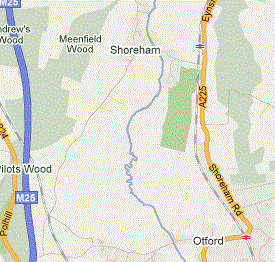 While here's the basic view from OSM:
 There's simply more information - those red-dotted lines, for example, are footpaths, which Google doesn't show. (I also think it looks better - nicer fonts etc - but that's a personal preference.)
But the real strength of OSM is that users can select the information they want to include. Someone has used the OSM data to produce an OpenCycleMap. Here's its version:
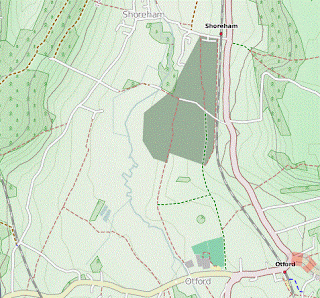 You can see how the roads are rendered differently - cyclists don't need to know that the road is the A225 - some information is left out, but some is included. You can't see it much on this extract, but it shows cycleroutes and - really important for cyclists - it shows contours.
The OSM project is a kind of wikipedia, and like wikipedia is only as good as the people who edit it. The perverse advantage OSM has is that you need a certain level of expertise to edit it, and to create specialised maps from the data. On the other hand, that means that certain parts of the world are poorly covered.
But, if you've got GPS equipment and want to fill in some of the gaps, it's probably not that difficult. Why not try it?
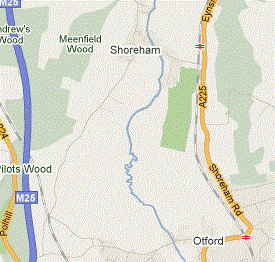

But the real strength of OSM is that users can select the information they want to include. Someone has used the OSM data to produce an OpenCycleMap. Here's its version:
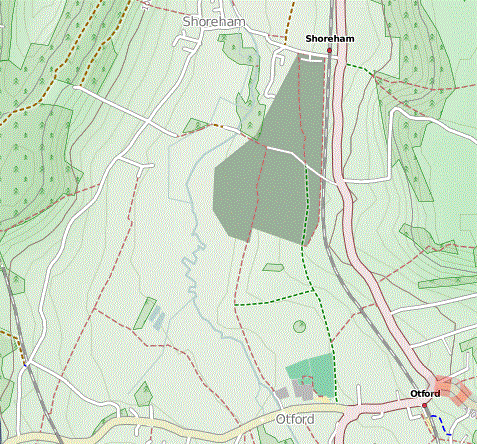
The OSM project is a kind of wikipedia, and like wikipedia is only as good as the people who edit it. The perverse advantage OSM has is that you need a certain level of expertise to edit it, and to create specialised maps from the data. On the other hand, that means that certain parts of the world are poorly covered.
But, if you've got GPS equipment and want to fill in some of the gaps, it's probably not that difficult. Why not try it?
25 May 2011
Nothing has been done about Sam Wollaston
I don't get many visitors to this blog, and I don't complain about that: it's too irregular and too unfocussed to build up a following. (More than half the visitors I do get only come here because they think they're going to see something about Charlton, and more than half the time they're disappointed.)
But one of my posts that's always attracted a trickle of views dates back to April 2009. I suppose it turns up when people do a search for Sam Wollaston. Why would people google him? I think it's unlikely that people want to know more about him - he's adequately forthcoming himself about his own life, his career, his girlfriend, etc - but I like to think it's people looking for someone else who shares their disbelief that he keeps his job.
And now, more than two years later, I've got my first comments on the post, and I'm pleased to say they support this hypothesis. In fact the first commenter, Ronniespraggs, makes me look like Wollaston's biggest fan.
As for me, I've almost stopped looking at Wollaston's columns. I know that people will say that's what I always should have done: if you don't like it, don't read it. But for me the real pity of Wollaston's writing is the opportunity cost: the Guardian's TV review could be, and used to be, one of the delights of the paper, one of the first things I'd turn to. Ronnie and Linda's comments have made me look at his latest two columns, and it doesn't seem things have changed. This makes me sad.
But one of my posts that's always attracted a trickle of views dates back to April 2009. I suppose it turns up when people do a search for Sam Wollaston. Why would people google him? I think it's unlikely that people want to know more about him - he's adequately forthcoming himself about his own life, his career, his girlfriend, etc - but I like to think it's people looking for someone else who shares their disbelief that he keeps his job.
And now, more than two years later, I've got my first comments on the post, and I'm pleased to say they support this hypothesis. In fact the first commenter, Ronniespraggs, makes me look like Wollaston's biggest fan.
As for me, I've almost stopped looking at Wollaston's columns. I know that people will say that's what I always should have done: if you don't like it, don't read it. But for me the real pity of Wollaston's writing is the opportunity cost: the Guardian's TV review could be, and used to be, one of the delights of the paper, one of the first things I'd turn to. Ronnie and Linda's comments have made me look at his latest two columns, and it doesn't seem things have changed. This makes me sad.
03 May 2011
The missionary vanishes
As I've noted before, waking up early gives you the opportunity to listen to American evangelical preaching, and this morning at 5 am Pastor David Jeremiah told the story of Jenny Adams, a Baptist missionary in Trujillo, Peru. Even at that time of day the story sounded strange, so I decided to investigate it further.
Here's what Jeremiah said.
Jenny Adams had been a missionary for 34 years. One day, she gave a lift to a young woman, without knowing that the woman's brother was a cocaine refiner, and she was carrying 3.9 kilogrammes of the drug. The police found this in Adams's vehicle, and so she was charged with possession (and presumably with intent to deal). The Peruvian legal system presumes guilt until innocence is proved (apparently), and so the local newspapers started printing stories about the "cocaine missionary". Adams was in prison for 20 days (so we must assume she was cleared of any charges).
Jeremiah's point is that this was an example of anti-Christian harassment. As a symbol of north American Christianity, Adams and her mission were vilified on this pretext, and no account was paid to her 34 years of unblemished service.
My first thought was that all over the world people are stringently punished for suspected drug offences, whether they are Christian or not. If there was any vindictiveness aimed at Adams or her mission it was more likely to be anti-imperialist that anti-Christian. And she was apparently acquitted. Good, but all over the world there are people in prison for long terms who might have done nothing worse.
So I decided to find out more about Jenny Adams. Jeremiah had mentioned what sounded like direct quotations from Peruvian newspapers, so it shouldn't be too hard to find. He must have read the story somewhere, and as he presumably doesn't read the Peruvian press, it must have turned up in some American media. And if the story is so heinous, at least some American Baptist websites would cover it.
Google searches for "Jenny Adams peru" and "Jenny Adams baptist" hardly help at all. I find one page which identifies Jenny Adams as a missionary in the Iglesia Bautista de Samne, 50 kilometres from Trujillo, so that must be her: the name must be right. But nothing about drugs. Even that snappy headline "cocaine missionary" doesn't give anything.
I'm honestly surprised that there is no trace of the story, and caught between disappointment and delight. I feel like it's possible I've caught Jeremiah out in an act of fiction, to put it nicely, but I'd be happier if I could be sure that the Jenny Adams story is not as he told it. What started out as a fairly weak attempt to show that Christians are persecuted merely for being Christian turns out to be a story that - so far - only exists in the world of David Jeremiah. But if anyone knows better, please let me know.
EDIT: I'm grateful to Anonymous(1) for the link and happy to see that the Jennie Adams story is true. I don't agree with a lot of what missionaries do, but I admire her evident fortitude. I had got the impression that this had happened quite recently, but that's clearly not the case, which would explain why it was hard to find any trace on tinternet. I'm also happy to withdraw any suggestion that Dr Jeremiah had made it up: it's natural that he would have known personally of Jennie Adams's history.
Here's what Jeremiah said.
Jenny Adams had been a missionary for 34 years. One day, she gave a lift to a young woman, without knowing that the woman's brother was a cocaine refiner, and she was carrying 3.9 kilogrammes of the drug. The police found this in Adams's vehicle, and so she was charged with possession (and presumably with intent to deal). The Peruvian legal system presumes guilt until innocence is proved (apparently), and so the local newspapers started printing stories about the "cocaine missionary". Adams was in prison for 20 days (so we must assume she was cleared of any charges).
Jeremiah's point is that this was an example of anti-Christian harassment. As a symbol of north American Christianity, Adams and her mission were vilified on this pretext, and no account was paid to her 34 years of unblemished service.
My first thought was that all over the world people are stringently punished for suspected drug offences, whether they are Christian or not. If there was any vindictiveness aimed at Adams or her mission it was more likely to be anti-imperialist that anti-Christian. And she was apparently acquitted. Good, but all over the world there are people in prison for long terms who might have done nothing worse.
So I decided to find out more about Jenny Adams. Jeremiah had mentioned what sounded like direct quotations from Peruvian newspapers, so it shouldn't be too hard to find. He must have read the story somewhere, and as he presumably doesn't read the Peruvian press, it must have turned up in some American media. And if the story is so heinous, at least some American Baptist websites would cover it.
Google searches for "Jenny Adams peru" and "Jenny Adams baptist" hardly help at all. I find one page which identifies Jenny Adams as a missionary in the Iglesia Bautista de Samne, 50 kilometres from Trujillo, so that must be her: the name must be right. But nothing about drugs. Even that snappy headline "cocaine missionary" doesn't give anything.
I'm honestly surprised that there is no trace of the story, and caught between disappointment and delight. I feel like it's possible I've caught Jeremiah out in an act of fiction, to put it nicely, but I'd be happier if I could be sure that the Jenny Adams story is not as he told it. What started out as a fairly weak attempt to show that Christians are persecuted merely for being Christian turns out to be a story that - so far - only exists in the world of David Jeremiah. But if anyone knows better, please let me know.
EDIT: I'm grateful to Anonymous(1) for the link and happy to see that the Jennie Adams story is true. I don't agree with a lot of what missionaries do, but I admire her evident fortitude. I had got the impression that this had happened quite recently, but that's clearly not the case, which would explain why it was hard to find any trace on tinternet. I'm also happy to withdraw any suggestion that Dr Jeremiah had made it up: it's natural that he would have known personally of Jennie Adams's history.
Subscribe to:
Posts
(
Atom
)

 Posts
Posts


