Pages

Plasticise

02 June 2011

Open Street Map

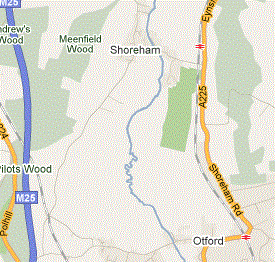
I don't think the Open Street Map is very well known. It ought to be. It's a collaborative attempt to map the world on a shared, free basis. And I think the results are better than most. Here's a part of the world where I went cycling today. First, here's how Google maps sees it.
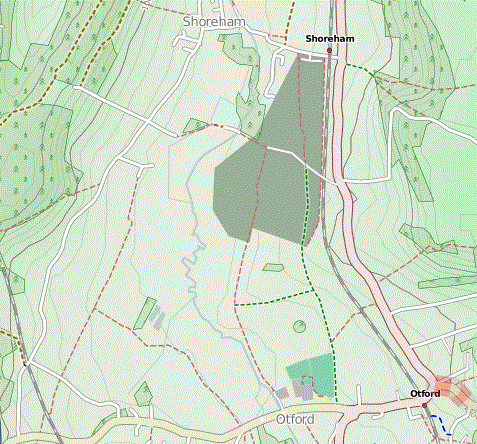
While here's the basic view from OSM:
There's simply more information - those red-dotted lines, for example, are footpaths, which Google doesn't show. (I also think it looks better - nicer fonts etc - but that's a personal preference.)

But the real strength of OSM is that users can select the information they want to include. Someone has used the OSM data to produce an OpenCycleMap. Here's its version:
You can see how the roads are rendered differently - cyclists don't need to know that the road is the A225 - some information is left out, but some is included. You can't see it much on this extract, but it shows cycleroutes and - really important for cyclists - it shows contours.

The OSM project is a kind of wikipedia, and like wikipedia is only as good as the people who edit it. The perverse advantage OSM has is that you need a certain level of expertise to edit it, and to create specialised maps from the data. On the other hand, that means that certain parts of the world are poorly covered.

But, if you've got GPS equipment and want to fill in some of the gaps, it's probably not that difficult. Why not try it?

25 May 2011

Nothing has been done about Sam Wollaston

I don't get many visitors to this blog, and I don't complain about that: it's too irregular and too unfocussed to build up a following. (More than half the visitors I do get only come here because they think they're going to see something about Charlton, and more than half the time they're disappointed.)

But one of my posts that's always attracted a trickle of views dates back to April 2009. I suppose it turns up when people do a search for Sam Wollaston. Why would people google him? I think it's unlikely that people want to know more about him - he's adequately forthcoming himself about his own life, his career, his girlfriend, etc - but I like to think it's people looking for someone else who shares their disbelief that he keeps his job.

And now, more than two years later, I've got my first comments on the post, and I'm pleased to say they support this hypothesis. In fact the first commenter, Ronniespraggs, makes me look like Wollaston's biggest fan.

As for me, I've almost stopped looking at Wollaston's columns. I know that people will say that's what I always should have done: if you don't like it, don't read it. But for me the real pity of Wollaston's writing is the opportunity cost: the Guardian's TV review could be, and used to be, one of the delights of the paper, one of the first things I'd turn to. Ronnie and Linda's comments have made me look at his latest two columns, and it doesn't seem things have changed. This makes me sad.

03 May 2011

The missionary vanishes

As I've noted before, waking up early gives you the opportunity to listen to American evangelical preaching, and this morning at 5 am Pastor David Jeremiah told the story of Jenny Adams, a Baptist missionary in Trujillo, Peru. Even at that time of day the story sounded strange, so I decided to investigate it further.

Here's what Jeremiah said.

Jenny Adams had been a missionary for 34 years. One day, she gave a lift to a young woman, without knowing that the woman's brother was a cocaine refiner, and she was carrying 3.9 kilogrammes of the drug. The police found this in Adams's vehicle, and so she was charged with possession (and presumably with intent to deal). The Peruvian legal system presumes guilt until innocence is proved (apparently), and so the local newspapers started printing stories about the "cocaine missionary". Adams was in prison for 20 days (so we must assume she was cleared of any charges).

Jeremiah's point is that this was an example of anti-Christian harassment. As a symbol of north American Christianity, Adams and her mission were vilified on this pretext, and no account was paid to her 34 years of unblemished service.

My first thought was that all over the world people are stringently punished for suspected drug offences, whether they are Christian or not. If there was any vindictiveness aimed at Adams or her mission it was more likely to be anti-imperialist that anti-Christian. And she was apparently acquitted. Good, but all over the world there are people in prison for long terms who might have done nothing worse.

So I decided to find out more about Jenny Adams. Jeremiah had mentioned what sounded like direct quotations from Peruvian newspapers, so it shouldn't be too hard to find. He must have read the story somewhere, and as he presumably doesn't read the Peruvian press, it must have turned up in some American media. And if the story is so heinous, at least some American Baptist websites would cover it.

Google searches for "Jenny Adams peru" and "Jenny Adams baptist" hardly help at all. I find one page which identifies Jenny Adams as a missionary in the Iglesia Bautista de Samne, 50 kilometres from Trujillo, so that must be her: the name must be right. But nothing about drugs. Even that snappy headline "cocaine missionary" doesn't give anything.

I'm honestly surprised that there is no trace of the story, and caught between disappointment and delight. I feel like it's possible I've caught Jeremiah out in an act of fiction, to put it nicely, but I'd be happier if I could be sure that the Jenny Adams story is not as he told it. What started out as a fairly weak attempt to show that Christians are persecuted merely for being Christian turns out to be a story that - so far - only exists in the world of David Jeremiah. But if anyone knows better, please let me know.

EDIT: I'm grateful to Anonymous(1) for the link and happy to see that the Jennie Adams story is true. I don't agree with a lot of what missionaries do, but I admire her evident fortitude. I had got the impression that this had happened quite recently, but that's clearly not the case, which would explain why it was hard to find any trace on tinternet. I'm also happy to withdraw any suggestion that Dr Jeremiah had made it up: it's natural that he would have known personally of Jennie Adams's history.
26 April 2011

Charlton 3 Rochdale 1

I started blogging Charlton matches to help me remember them. I've a terrible memory for sport of any kind, even for Charlton games. I think it's a specific Charlton gene, which scientists ought to name "Happy Oblivion 1905". The god-given process of evolution has fast-tracked, over 106 years, the development of protective amnesia. But the second half of this season has given us a series of games no-one would want to remember. So I stopped blogging them.

Yesterday's game wasn't one. I had even predicted a 3-0 win, based on a feeling that Chris Powell's approach is finally taking root. And that seems to be correct. All the team, ravaged as it is by injuries and bans, seemed comfortable and confident with the passing game. I suppose it helped that the season is truly dead now, and the result would change nothing, but the style of play makes me happy that I've renewed my season ticket. For weeks now, I've been wishing the season could end NOW, but now I wish it was just beginning.

If only we knew how to defend corners ...

17 April 2011

Homage to Phyllis Pearsall

What do the conflict in Israel/Palestine, the unrest in Libya, the unrest in Yemen, and the Greek financial crisis have in common? They're just four of the things for which someone has produced a "road map" as a solution.

The first reference I can find in the Guardian to a road map is in 2003, when an article prematurely claimed "the road map is dead". In those days the concept of "road map" was probably an optimistic replacement for the concept of "peace process" - after all, everyone knows that processed peace is less tasty and nutritious than fresh or frozen peace.

In 2005 a Guardian editorial declared that this road map was stalled - a lovely mixed metaphor, which should have warned people off using the phrase.

But this year the damned maps have been turning up all over the place. The world of politics has turned into a branch of Stanfords. In February an "official" said we need a road map of Egypt. In March, "In Yemen, the poorest country in the Arab world, the opposition presented President Ali Abdullah Saleh with a road map for a smooth transition of power this year" (that was nice of them). This month, April, the Vickers report apparently sets out "a road map for a better banking system in the UK", while the Greek Prime Minister has announced a "road map to recovery".

So many maps, but no-one knows where they're going. You can understand why demagogues love to say they have a road map. It announces a certainty about things: who can argue with a road map? What it actually reveals - like all clichés - is a lack of imagination or creativity. Phyllis Pearsall - who mapped out the original and best road map, London's A to Z, by tramping the streets for 18 hours a day - should haunt and torment the people who spout the cliché. A road map, a good one, a real one, like hers, is so much more than a list of good or unrealistic or self-seeking intentions.

09 April 2011

Incidentally ...

The fact that I'm typing this proves that if you leave your mobile phone on, the plane won't necessarily come crashing down. I was sure I'd turned it off - apart from anything, the battery was running down and I wanted to conserve it. So it was stuffed into the hand luggage in the locker.

So when the plane landed and I heard the text message tone - a swirly tune with bird tweets - I thought how interesting, someone else has that tone. And tsk, they haven't turned their phone off. Then I heard the same tone a few more times and I still didn't get it, still thought there must be a lot of people with the same phone as me.

It was only when I got on the train that I found my phone had been turned on all the time, and had picked up eight messages in the air: Welcome to Spain; how to use your phone in Spain; Welcome to France; how to use your phone in France; Welcome to Britain; how to use your phone in Britain; service message please delete; service message please delete.

In the modern world this is as close as you can get to a death-defying experience. I've never felt more alive.

07 April 2011

Confessions of a rubbish tourist (2)

Pretentious tourists call themselves travellers. I'm by nature a holidayer, a tripper, and I sometimes think that I'd be happiest holing up for two weeks in a chalet in Leysdown, with a good supply of books and beer.

And, of course, a telly. I love watching foreign television even if, especially if, I don't understand it. I could probably spend all day in my room flicking through the channels. The hotel in Lisbon had these:

4 Portuguese channels, ARD, TV Italia,  BBC World News (which had an alarming obsession with the coming royal wedding), Swiss TV5, Eurosport (which was showing a snooker match that seemed to be lasting a week), CNN and CNBC (both news porn for the tired businessman), RTE Internacional, some Russian language station, and RT (Russia Today) dubbed into Spanish.

The best show was RTP1's version of This Morning, called A Praca da Alegria. Each show begins with a musical performance. Here are the bands they had on Monday and Tuesday.

and while they play their slightly folkloric tunes, the studio audience dance fairly gingerly.
After that, they get an expert in to discuss a consumer/lifestyle issue. On Monday, it was a body posture expert discussing how to tell if your suitcase is too heavy. (Hasn't he heard of wheels? Every bloody suitcase in the world has wheels these days. Noise levels at airports are reaching dangerous heights with the clickety clack of them on the terrazzo tiles.)

If I had my way, if I wasn't scared of being judged by the hotel staff, I'd only leave my room for food. Actually, in Portugal not even for that. I hate to say it, but Portuguese food is dull. I like salt cod as much as anyone, but it needs something like a spicy tomato sauce to bring it to life. I think there's no word for 'spicy' in the Portuguese language. There is certainly no entry in my English/Portuguese dictionary for 'spicy'. Someone's crossed it out, possibly in every copy.